

How does Inflation impact Crypto prices?
A look at the relationship between the CPI, inflation and the impact on Crypto currencies.
Every month, the US releases the Consumer Purchasing Index (CPI). The CPI tracks the monthly change in prices paid by US consumers for their average basket of goods and services. In this blog we will answer the question ‘How does Inflation Impact Crypto prices’?
The CPI is also an inflation marker. The higher the percentage, the more the cost of living is rising and the purchasing power of the dollar is falling. This leads to inflation, inflation then leads to interest rate increases, which in turn reduces the amount we spend and hopefully then helps to reduce inflation. And the cycle continues.
In this blog we will look at the latest CPI data (released on the 10th June 2022) and the implications on Crypto currencies.
Key topics to cover in this blog are:
- The CPI calculation
- The results for May 2022?
- How does Inflation impact Crypto prices?
- Is this a time to panic?
- How do you mitigate the effects of inflation on Cryptocurrencies?
- Why do cryptocurrencies not act the same as traditional financial markets?
Calculating the CPI
The CPI is calculated by taking the prices of a fixed basket of goods and services. These are then compared to the prices of that same basket in a previous period. The CPI basket includes items like food, housing, transportation, medical care, and recreation.
The CPI has a significant impact on cryptocurrency prices. There are a few different scenarios when the CPI results go live. If inflation comes in higher than expected, it could be seen as a positive for crypto and other asset markets. This is because higher inflation generally leads to more stimulus from central banks, which can be bullish for risk assets.
Conversely, if inflation comes in lower than expected, this would have a negative impact on crypto and other asset markets. This is because lower inflation generally leads to less stimulus from central banks, which can be bearish for risk assets.
CPI impacts on Stock and Bonds Markets
The CPI results could also have a different impact on other markets. For example, when inflation comes in higher than expected, it could be bullish for crypto but bearish for bonds. This is because higher inflation generally leads to higher interest rates, which can be negative for bonds.
Bitcoin is seen as a hedge against inflation due the finite number of coins that will ever be mined. This is because they are not subject to the same monetary policies as fiat currencies. For example, if a central bank prints more money, this can lead to inflation. However, there is a limited supply of Bitcoin and other cryptocurrencies, which helps to protect against inflation.
Historically, the CPI has had a mixed impact on Bitcoin. In the past, higher-than-expected CPI results have often been positive for Bitcoin, as they have led to more stimulus from central banks. However, lower-than-expected CPI results have sometimes been negative for Bitcoin, as they have led to less stimulus from central banks.
CONSUMER PRICE INDEX – MAY 2022
The Consumer Price Index for All Urban Consumers (CPI-U) increased 1.0 percent in May. This is on a seasonally adjusted basis after rising 0.3 percent in April. Over the last 12 months, the all items index increased 8.6 percent before seasonal adjustment.
What happened next and how does Inflation impact Crypto prices??
With the U.S. consumer inflation in May reaching 8.6%, the highest level for more than four decades, stock markets fell sharply. The Dow Jones Industrial Average fell around 2.7%, or about 880 points in one day. Technology shares slid along with banks and consumer shares, sending the S&P 500 down 2.9% and the Nasdaq Composite down 3.5%.
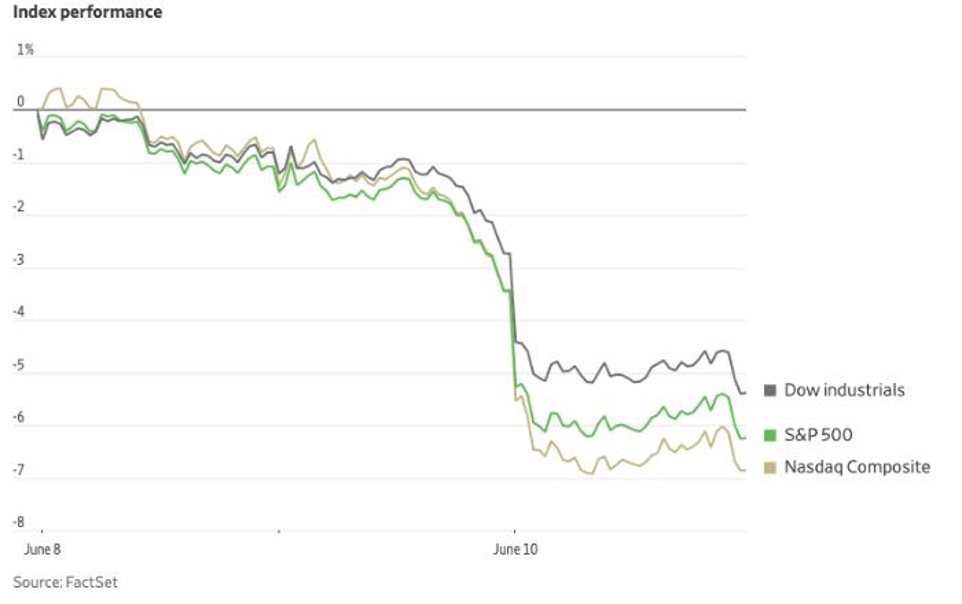
How does Inflation impact Crypto prices?
The Crypto market however, saw a more dramatic loss, with Ethereum and Bitcoin both losing significant value. Ethereum dropped from $1787 on June 10th to $1130 by June 20th (-36%). Bitcoin slid down over 39% from $30,101 on June 10th to $19,930 by June 20th.
In spite of higher inflation figures, Crypto still suffered, even though it is in theory at least, a hedge against inflation. Why is this? Well, there is more at play here as news about the global economy seems to be heading us toward a period of recession. In uncertain times, many investors will divest from more volatile investments in favour of safer havens. There have also been a few negative stories coming from the Crypto segment recently, with the quite shocking collapse of Luna and UST. There will always be the usual effects of FUD (Fear Uncertainty and Doubt) kicking in when the candles run red not green. So, the reason for the drop in Crypto is more likely to be a combination factors, plus the fact that this is simply where we are with the Cycle. As we head towards the next halving in 2024, the patterns and trends will surely take a similar shape to previous cycles and so………
Is this a time to panic?
Well, volatility has a very unique way of changing, when you change your perspective, or in this instance, your time horizon. Let’s for example, change the above numbers from a ’10 day view point’ to a ‘3 year view point’. This tells a very different story.
The price of Bitcoin on June 10th 2019 was $8204 and Ethereum was $232. So as a new asset class, Bitcoin has grown 142% and Ethereum has grown 387% over 3 years. That is not a bad ROI if you had bought and held! So turbulence and rough waters certainly look a lot calmer over time.
If you are not of the mindset to simply buy and hold, then trying to time any market is very difficult if not impossible. Some models help assess risk levels and so it is super important that you are comprehensively thorough with your research before you make any decisions to buy or sell. One fundamental however, is that all markets work through cycles and Bitcoin is no different in this respect.
The BITCOIN Regression Model
Let’s take a quick snap shot of the Bitcoin history over time!
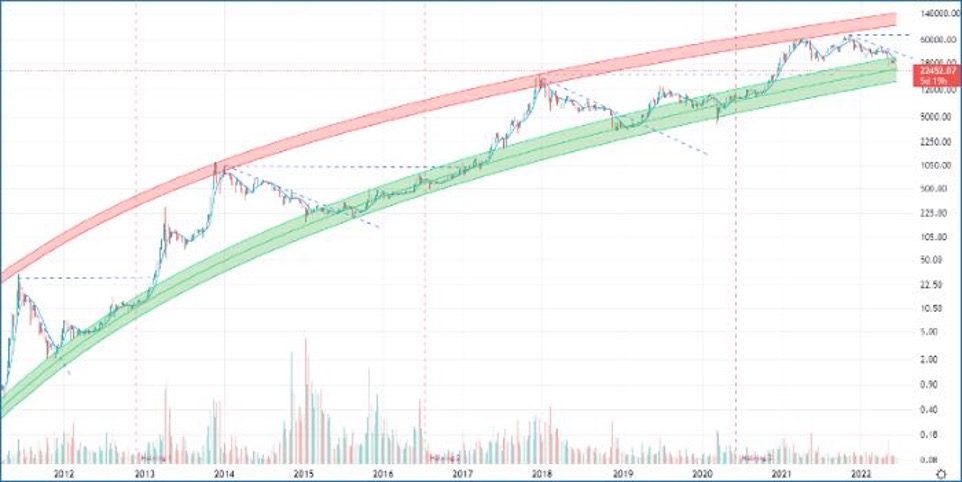
The above logarithmic Regression Model shows how Bitcoin (and Cryptos) evolve in cycles as they mature because of BTC reward Halvings.
Upper red band – High Risk and Bitcoin is overbought
In between the Red and Green Bands – within a Bull Cycle (Ideal to HODL)
Green Lower Band – Risk is low and Bitcoin is getting over sold
The Crypto College team performed an analysis on a long-term logarithmic regression model and uses this as an example for context only, not intending to provide any financial advice
So how do you mitigate the effects of inflation and other turbulence on a volatile new asset class such as Cryptocurrencies?
What action should you take to mitigate the effects of inflation?
So what should crypto investors do in light of it’s certain volatility? Nothing, according to most experts. Given crypto’s history of volatility, the current decrease doesn’t guarantee a long-term or permanent reversal or decline.
Bitcoin’s price is just as likely to climb, as it is to fall, however, we are no doubt in the midst of a Crypto Winter presently and so this part of the ‘cycle’ could easily last for up to two years before a major breakout occurs again or we head towards the next bull run.
The future of cryptocurrency is sure to continue with its volatility, and experts say that’s something long-term crypto investors will have to continue dealing with.
If you’re thinking about investing in cryptocurrencies, the best advice is to do plenty of your own research and if you want to protect your portfolio from inflation, then consider how to invest in cryptocurrencies that have built-in mechanisms to protect against it. One example potentially is Bitcoin, which has a limited supply of 21 million coins. This means that as demand for Bitcoin increases, the price will go up, potentially making it a good hedge against inflation.
Another way to protect your portfolio is to invest in assets that tend to do well during periods of high inflation, such as gold or real estate. By diversifying your portfolio, you can minimize the effects of inflation on your investments. (Not financial advice)
Why do cryptocurrencies not act the same as traditional financial markets?
Finally, we have seen that the impact of the CPI hit traditional stock markets as investors become nervous about what comes next, but why did Crypto see a bigger decline? Well, people do not understand cryptocurrencies well because they are a new asset class. In addition, cryptos are not subject to the same regulations as traditional financial assets and this makes them more volatile and less predictable than stocks or bonds.
As more people become familiar with cryptocurrencies and their underlying technology, it is likely that they will become more stable. In the short term, investors should be prepared for a higher degree of volatility
Final thought
One final thought if you are considering investing in Crypto is for you to consider becoming part of a community where you can share and talk about your own research, views and experiences. As a new investor, this is often a great way to start your journey by gaining the insights from others who have walked the path before you and learned from their own personal experiences already and are willing to share them. If you feel that this would help you, then why not sign up and join our Crypto College Community here and see how you can benefit.
Good luck and see you back here again soon!
Jack
Important Disclaimer:
The content of this article or any content from CryptoCollege.cc is for educational purposes only. It is not investment advice. Therefore, investors must do their due diligence before making any type of investment decision. Read more here.
CC Learn and Earn Bitcoin Program:
We give part of our YouTube advertising revenues in Bitcoin (Sats) to our community. To participate, subscribe to our YouTube Channel and complete the educational challenges we launch on our various Social Media @CryptoCollegeCC . Read more about the CryptoCollege.cc Learn and Earn Program here.
Support and Donations:
If you find our content useful and want to support us. You can either follow us on Social Medias @CryptoCollegeCC or donate to the below addresses. Thank you for your support!
Bitcoin: bc1q85ngl882te4rqery2028auha8dsxlsu89aqjxqle0n6zkuqg5a6q3m38t5
Ethereum or ERC20 Token: 0xc873fBcB5DB38B87CaC2e02C28A5C504eC673d62


You may also like

The Libra Scandal in Argentina and President Milei’s Involvement

What is Fractional Banking and how it impacts you
