

What happened in 1971? The Nixon Shock!
The Nixon Shock!
In 1971, President Richard Nixon made the decision to remove the United States dollar from the gold standard, a system in which the value of the dollar was directly tied to the value of gold. This decision, known as the Nixon Shock, had a number of significant consequences for the global economy.
One immediate consequence of the Nixon Shock was that it allowed the Federal Reserve to greatly increase the money supply in the United States (see below graph). This led to higher inflation, as there were more dollars in circulation but no corresponding increase in the amount of goods and services available to purchase. This inflation was particularly damaging to those on fixed incomes, such as retirees, and it also made it more difficult for businesses to predict future costs and plan accordingly.

Another consequence of the Nixon Shock was that it led to a dramatic increase in the trade deficit in the United States. Without the gold standard to back the dollar, other countries were less likely to want to hold dollars as a reserve currency. This led to a decrease in the value of the dollar on the global market, making imports more expensive and exports less competitive. The below chart shows how the productivity trend decoupled from compensation in 1971.

The Nixon Shock also had long-term consequences for the global economy. By breaking the link between the dollar and gold, it led to a shift towards floating exchange rates, that determines the value of a currency by supply and demand in the foreign exchange market. This has made it more difficult for governments to control the value of their currency, and it has also led to increased volatility in currency values.
Consequences of the Nixon Shock
Overall, the Nixon Shock of 1971 had a number of significant consequences for the United States and the global economy. It led to higher inflation, a larger trade deficit, and a shift towards floating exchange rates. We still feel the consequences of the Nixon shock today and and it continues to lead to more volatile and uncertain global economic environment. A clearly illustration (see below) of those consequences, is the time it takes for an average American to buy to buy an average house. It has almost tripled since the Nixon shock!
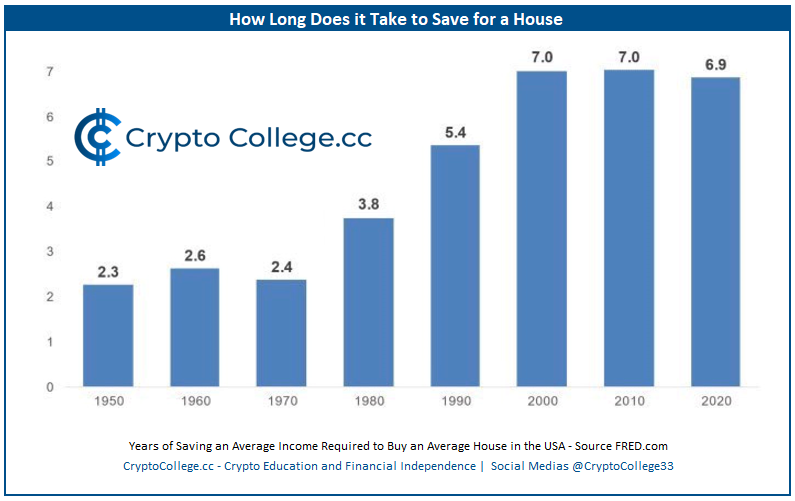
The main driver for those consequences is the unlimited and excessive printing of USD by the government. And unfortunately this has gotten worst with the COVID crises where the FED printed more than 50% of the entire volume of USD in less than two years. This is one of the main arguments for Bitcoin, because it has a fixed supply of 21 million, making it a hard asset. This is one of the reasons why Fidelity believes one Bitcoin could be worth $100 million by 2035. If you want to understand more about it please check our Bitcoin Business Case Course.
Important Disclaimer:
The content of this article or any content from CryptoCollege.cc is for educational purposes only. It is not investment advice. Therefore, investors must do their due diligence before making any type of investment decision. Read more here.
CC Learn and Earn Bitcoin Program:
We give part of our YouTube advertising revenues in Bitcoin (Sats) to our community. To participate, subscribe to our YouTube Channel and complete the educational challenges we launch on our various Social Media @CryptoCollegeCC . Read more about the CryptoCollege.cc Learn and Earn Program here.
Support and Donations:
If you find our content useful and want to support us. You can either follow us on Social Medias @CryptoCollegeCC or donate to the below addresses. Thank you for your support!
Bitcoin: bc1q85ngl882te4rqery2028auha8dsxlsu89aqjxqle0n6zkuqg5a6q3m38t5
Ethereum or ERC20 Token: 0xc873fBcB5DB38B87CaC2e02C28A5C504eC673d62


Tag:Bitcoin, Hard Money, History, Inflation

You may also like

The Libra Scandal in Argentina and President Milei’s Involvement

What is Fractional Banking and how it impacts you
