

SHA-256 and its Crucial Role in Bitcoin Security
In the realm of cryptocurrencies, security is paramount. The underlying technology that ensures the integrity and immutability of transactions within the Bitcoin network is SHA-256. This is basically what is known as a cryptographic hash function. In this article, we will delve into the details of SHA-256 and explore how it is intricately woven into the fabric of Bitcoin’s blockchain.
What is SHA-256?
SHA-256, which stands for Secure Hash Algorithm 256-bit, is a member of the SHA-2 family of cryptographic hash functions. Created by the National Security Agency (NSA) and published by the National Institute of Standards and Technology (NIST) in 2001, SHA-256 is designed to take an input message and produce a fixed-size output, typically a 256-bit hash value. This process is a one-way function, meaning it is computationally infeasible to reverse the process and obtain the original input from the hash.
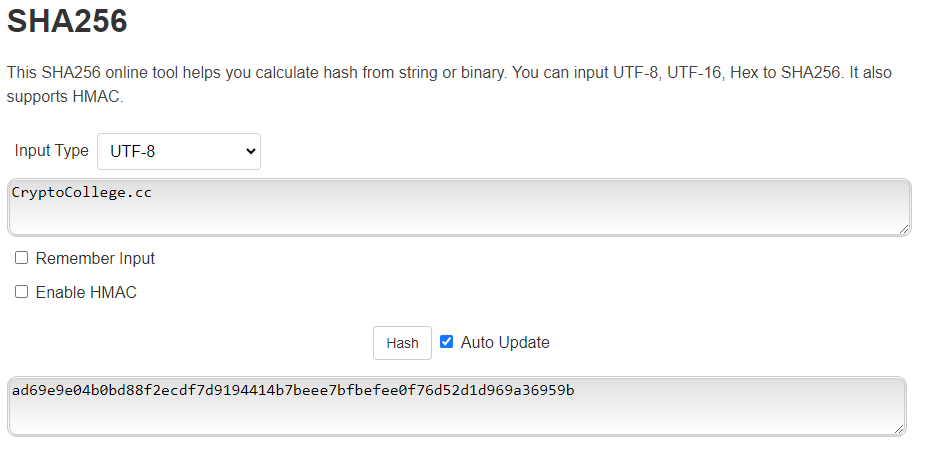
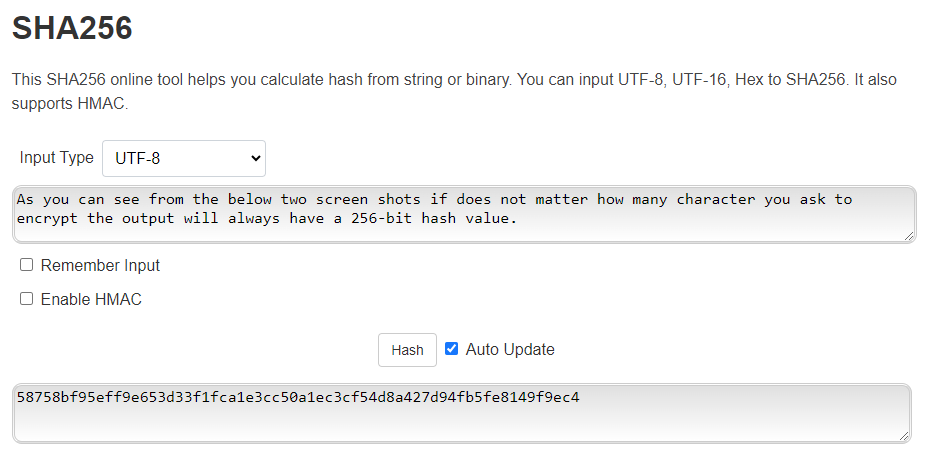
You can find here, an online tool that allows you to play with the cryptographic hash function. As you can see from the below two examples it does not matter how many character you ask to encrypt the output will always have a 256-bit hash value.
The Mathematics Behind SHA-256:
At its core, SHA-256 employs complex mathematical operations to transform an input into a fixed-length output. The algorithm involves bitwise operations, modular arithmetic, and logical functions, creating a hash that is unique to each unique input. The key properties of SHA-256 include something called collision resistance. This means it is exceedingly improbable for two different inputs to produce the same hash. It also has an avalanche effect, where a small change in the input results in a drastically different hash.
SHA-256 in Bitcoin:
Bitcoin’s blockchain relies on SHA-256 as the foundation of its security model. When a user initiates a transaction, the details of that transaction, along with other relevant information, are fed into the SHA-256 algorithm. The output, known as the transaction hash, becomes the unique identifier for that specific transaction and is crucial for maintaining the integrity of the blockchain.
Block Hashing and the Proof-of-Work Mechanism:
Bitcoin organizes transactions into blocks, and each block contains a reference to the hash of the previous block. This creates a chain of blocks, forming the blockchain. Miners, who play a pivotal role in the Bitcoin network, compete to solve a cryptographic puzzle by finding a nonce (a random number). When combined with the block data, this produces a hash value that meets certain criteria. This process, known as proof-of-work, requires significant computational power and serves as a consensus mechanism, preventing malicious actors from easily altering the transaction history.
Immutability and Security:
The use of SHA-256 in Bitcoin contributes to the immutability and security of the blockchain. Once a block is added to the chain, altering any part of it would require changing the block’s hash. Since the output of SHA-256 is unique to the input data, even a minor alteration would result in a completely different hash. This makes it extremely challenging for attackers to tamper with past transactions without altering all subsequent blocks – A task that becomes exponentially difficult as the blockchain grows.
To wrap it up:
SHA-256 is a cornerstone of Bitcoin’s security architecture, providing the cryptographic foundation for transaction integrity and immutability. The algorithm’s one-way nature and collision resistance make it a robust choice for securing the decentralized and trustless nature of the Bitcoin network. As cryptocurrencies continue to evolve, the significance of SHA-256 in ensuring the reliability and security of blockchain systems cannot be overstated.
Important Disclaimer:
The content of this article or any content from CryptoCollege.cc is for educational purposes only. It is not investment advice. Therefore, investors must do their due diligence before making any type of investment decision. Read more here.
CC Learn and Earn Bitcoin Program:
We give part of our YouTube advertising revenues in Bitcoin (Sats) to our community. To participate, subscribe to our YouTube Channel and complete the educational challenges we launch on our various Social Media @CryptoCollegeCC . Read more about the CryptoCollege.cc Learn and Earn Program here.
Support and Donations:
If you find our content useful and want to support us. You can either follow us on Social Medias @CryptoCollegeCC or donate to the below addresses. Thank you for your support!
Bitcoin: bc1q85ngl882te4rqery2028auha8dsxlsu89aqjxqle0n6zkuqg5a6q3m38t5
Ethereum or ERC20 Token: 0xc873fBcB5DB38B87CaC2e02C28A5C504eC673d62


Tag:Bitcoin, Encryption, security

You may also like

What is Fractional Banking and how it impacts you

The US Bitcoin Strategic Reserve
